

Product Certainty is an Illusion
And how the Now-Next-Later framework can save your sanity

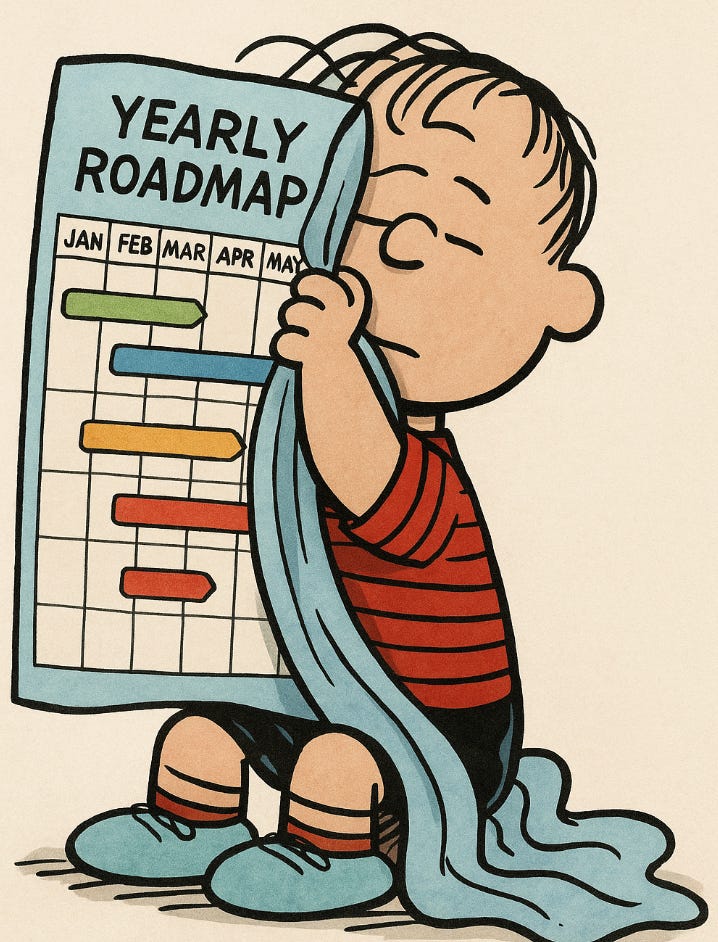
Has your product roadmap been lost in a Slack channel or forgotten in Notion?
In today’s world, with AI and market shifts accelerating, you’d have more luck predicting the weather than locking down an annual plan.
Longer timelines don’t equal better strategy.
They mean you’re more emotionally invested in a plan unlikely to survive reality.
What Works: Intentional Uncertainty
I’ve been coaching product leaders facing this challenge. The thriving ones aren’t those who know exactly what they are doing six or nine months out. They’re those who have embraced shorter cycles while maintaining clarity about their direction.
What I call “intentional uncertainty”.
My tool of choice is the Now-Next-Later framework. Kudos to Janna Bastow (of Mind the Product and ProdPad) who invented it in 2022.
I wrote this article as I’ve been recommending it more and more for these reasons:
New AI capabilities emerge weekly that change approaches.
Competitors are using AI tools to personalize in unexpected ways.
Customer needs are evolving as AI resets what’s possible.
Regulatory landscapes are introducing increased uncertainty.
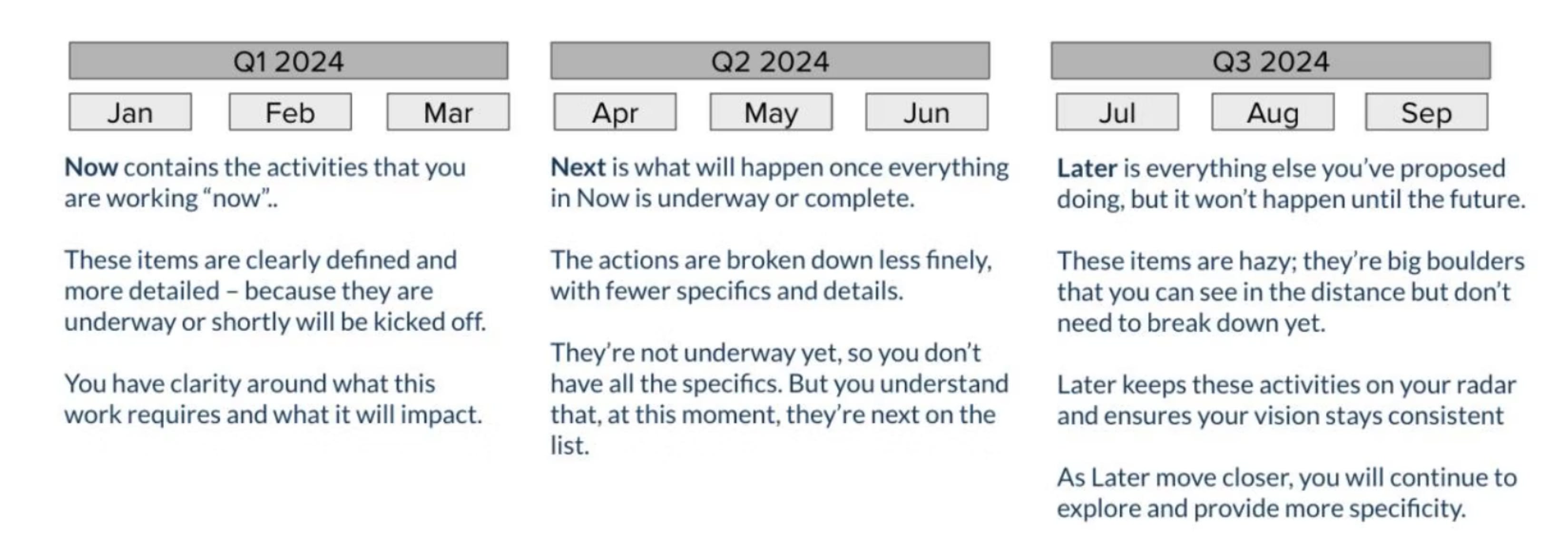
My advice.. Instead of pretending to see 12 months into the future, divide your planning into three time frames:
NOW (This Quarter) Get granular and specific. The current quarter is underway. Be detailed here because the variables are fewer and more predictable. Outputs: committed epics, dependencies, and owners.
NEXT (Following Quarter): Build in flexibility. Focus on strategic priorities and acknowledge assumptions to be tested. Think outcomes rather than locked in features. Outputs: 2–3 themes with success criteria and top risks.
LATER (Two Quarters Ahead): This is a strategic direction and vision, not a feature list. It says “here’s where we’re headed” without claiming to know the exact path. Outputs: directional theses and options, not commitments.
Recent Roadmap Experiences
You’ll still encounter execs and partners who believe a strategy and supporting plan must be locked down a year in advance.
Here are ways I’ve helped clients ease others into the Now-Next-Later approach.
CEO demands a roadmap for the board
A CPO I work with was mandated by her CEO to create a detailed roadmap for a board meeting in two weeks. My client is new to the company and wanted to impress.
She shared a draft with the CTO, who wasn’t briefed by the CEO on the request. Feeling sidelined, the CTO halted the process.
We reset using Now-Next-Later: lock Q1 commitments, outline Q2 themes, and keep a Q3 wishlist.
My client and the CTO aligned on Q1, then iterated with the CEO. Together they refined Q2 themes, deferring specifics until Q1 learnings. For the longer horizon, a one pager with three plausible paths, each with assumptions and pivot triggers was drafted.
The board had future visibility without false certainty. Tensions were eased with a workable path forward.
Stakeholders require an annual roadmap
I watched this play out with a product leader at a complex enterprise organization. They were acquiring a company and another reorg had just been announced.
His Marketing and Customer Success counterparts wanted year‑long certainty for budgeting. A locked roadmap would have imploded amid shifting leaders and unknowns.
We moved to Now-Next-Later planning: Q1 locked, Q2–Q3 framed as themes with assumptions. Budgets mirrored the Q1 plan with Q2–Q3 ranges tied to triggers (e.g., cohort retention, partner launch).
Teams gained ownership, and my client kept all parties moving without false certainty.
What about strategy and vision?
Every product vision derives from the organization’s strategy and vision. It’s the product team’s job to realize the organization’s vision through the product.
With Now-Next-Later you can be rigid in vision and adaptable in execution.
Here are a few tips:
Constantly share your vision (people need to hear things 7 times to remember)
Focus on time periods (months, quarters) and intention vs. specific dates.
Break work into “chunks” to define what to do and when
Reassess with monthly or quarterly retrospectives
It takes getting used to, but the benefits are worth the effort. If you can deliver for Now, you’ll gain the backing to proceed with your approach to Next.
Not convinced, run an experiment. As Anne-Laure Le Cunff of Ness Labs shares:
We’ve all been there: you’re about to make a decision, but somehow the more you research, the harder it becomes to choose… If that sounds familiar, you’ve likely run into FOBO (the Fear of a Better Option).
Most decisions won’t define your entire future, and waiting for absolute confidence often costs more than it saves. Practice making the best choice available now, take action, and learn from the result.
Counterintuitive Benefits
The product leaders I’m coaching who made this shift report:
Less stress and defensiveness around plans
More flexibility to take advantage of emerging opportunities
Better alignment among teams and partners
And, surprisingly, improved delivery against their strategic priorities.
Why? They’re not wasting energy defending obsolete plans or forcing teams to execute irrelevant features. They’re adapting as they learn. The Now - Next - Later rhythm creates faster feedback loops and clearer trade-offs.
Next Steps
Your product doesn’t need a year mapped out in advance. It needs:
An actionable “new” quarter
Informed intuition for the “next” one
Steady direction towards the “later” horizon
If you’re struggling with the tension between planning and adaptability, I’d love to hear about your experience. How are you managing roadmapping in this era of constant change?
Reply to this email or comment below. Lancaster and I read every response!

P.S. If you found this helpful, share it with a product friend. If you’re not subscribed, join us! Here are a few other ways to connect.
Reach out over LinkedIn: Diana Stepner
Curious about coaching? Let’s talk.
Explore my product leadership collection on Wizly.
This is a really potent framework, Diana.
We know most corporations don't know what they will do next month, let alone next quarter. But this framework does create a continuum and a repository of relevant ideas/opportunities that companies can leverage when they're ready.
And as Hubert said, very useful for monetization too.
The framework is perfect for monetization managers. Goes well with new features for tools, applications, sale cycles, and etc. To be able to see in the near feature allows time for teams to take advantage of the opportunities.