

Don’t Outsource Learning
AI is making human connection more significant, not less. Make learning your team’s job and your 2026 edge.

As tech tools become more powerful, conversations return to layoffs.
Product leaders are led to believe their teams don’t need them.
Here’s the truth: the opposite is happening.
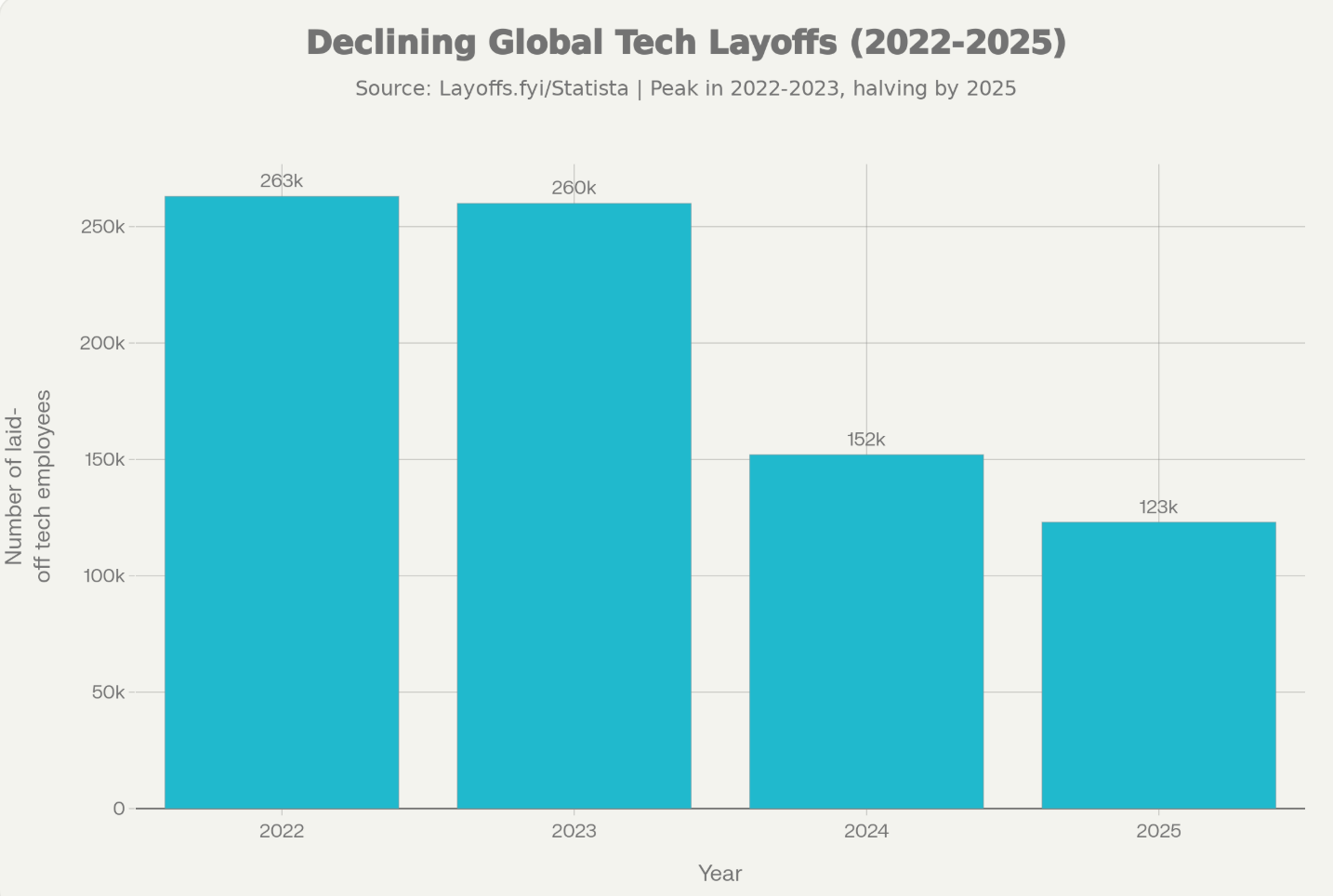
Despite over 1.2 million layoffs in 2025 amid the government shutdown and slower hiring in retail, transportation, and construction (see LinkedIn), numbers are dropping in tech.
I used to think efficiency was the goal. Faster outputs, fewer handoffs, leaner teams.
Then I watched organizations automate themselves into a corner. They shipped faster while learning nothing. Optimized metrics while overlooking what customers needed.
Does that sound familiar?
Ben Thompson recently argued that AI abundance is increasing the value of humans due to our imperfections and quirks that lead to creative and innovative work.
Right now it is individual humans who are uniquely capable to reach audiences at scale; AI, on the other hand, is about scaling compute to deliver results to individuals.
Even if AI does all of the jobs, humans will still want humans, creating an economy for labor precisely because it is labor…. even if we can’t possibly imagine what those jobs might be.
Gen Z doesn’t just tolerate humans. They seek them out. They want to return to the office for mentoring and meaning (BuiltIn).
Looking backward (even to 2025) and return to office mandates don’t enable companies to succeed.
When AI generates all output, everything looks the same. Insight and connection are seldom seen in the work.
Teams that prioritize people and connection will stand out in 2026.
Where human connection is essential in product work
Professor of management at Kellogg, Dashun Wang, shares what we know but tech exec behaviors imply otherwise: it’s not the failure that stops us, it’s the failure to extract and apply the learning (Radical).
Outsourcing all experimentation to AI means outsourcing the learning too.
That’s why we find win rates alone (the proportion of experiments finding winning treatments) too narrow. You can have a 0% win rate but still get huge business value from experimentation if you’re learning and mitigating the risks of making bad decisions.
1) Defining what to experiment on, not just running experiments.
Spotify’s R&D team made a surprising shift. They stopped measuring experiment “win rates” and started measuring learning.
This sounds logical until you remember we’ve built careers and laid off hundreds of thousands around the mythology of winning. Most leaders would recoil at an innovation team with a zero percent success rate, no matter the lessons learned. I’ve seen it happen: the team gets disbanded, the learning evaporates, and the organization stays where it started. The only difference is that they are now more risk averse.
AI can run your experiments faster. But deciding which questions matter, what counts as genuine insight, and what your organization needs to learn next?
That takes human judgment shaped by relationships —> with customers, teammates, and the market.
2) Managing risk through relationships, not only data
The best risk management I’ve seen doesn’t come from dashboards. It comes from the engineer who trusts you enough to say “this timeline worries me” before it’s too late. From the customer who tells you the real problem because you’ve earned that conversation.
AI can flag anomalies, but it can’t build the trust to surface the risks no algorithm would catch.
3) Understanding where customers’ lives would benefit, not just what they’re clicking
Product analytics show what users do. Human connection reveals why and what they wish to do but cannot.
That depth of understanding differentiates true innovation from incremental improvements.
The choice we face
Mel Robbins puts it simply: we can see today’s changes as threats or invitations. The AI age isn’t eliminating the need for human connection. It’s emphasizing its importance.
We can either automate ourselves into isolation, chasing velocity while relationships weaken, or we can recognize that every efficiency gain creates more space for the deeply human work only we can do: collaboration, empathy, and messy conversations that move organizations forward.
The teams that thrive won’t have the most sophisticated AI tools. Instead, they’ll treat human connection as their competitive advantage and invest in it accordingly.
How are you prioritizing human connection in your product work this year?
Go deeper on these themes
This tension between speed and depth is growing, and navigating it is a prime opportunity for people-first leadership. Specifically, how do we stay people-first amidst accelerating change?
These two pieces explore different angles on today’s theme.

→ Are you struggling with the tension between planning and adaptability? Product Certainty is an Illusion explores how Now-Next-Later planning creates faster feedback loops without false promises.

→ Want to uncover your leadership “why”? A Simple Framework for Reflecting on 2025 and Planning 2026 shows how to turn your reading highlights into a personal operating system.
People-First Leadership is a reader-supported publication. To receive new posts and support my work, consider becoming a free or paid subscriber. You’ll get to learn more about how Lancaster and I are prioritizing connection in 2026.

P.S. If you found this helpful, share it with a product friend. If you’re not subscribed, join us! Here are a few other ways to connect.
Reach out over LinkedIn: Diana Stepner
Curious about coaching? Let’s talk.
Explore my product leadership collection on Wizly.